

A second impaired driving charge engages the federal criminal law in a manner that is qualitatively different from a first offence. While provincial consequences, such as licence suspensions, administrative penalties, and ignition interlock conditions, remain relevant, they operate in parallel to and separate from the criminal proceedings. Ultimately, the federal criminal framework determines whether an accused will be incarcerated and carry a permanent criminal record.
This article addresses the federal criminal dimensions of a second impaired driving charge. We’ll explain the mandatory minimum penalties, the procedural requirements behind those penalties, the evidentiary defences, and the broader collateral consequences of a conviction.
Understanding Your Second DUI Charge
Impaired driving offences under s. 320.14 of the Criminal Code, including Impaired Operation, Operation with a Blood Alcohol Concentration Over 80 mg%, and Refusal to Comply with a Demand (s. 320.15), are hybrid offences.
The Crown retains the discretion to proceed by way of summary conviction or by indictment, which affects the available maximum penalties:
- By indictment: Maximum of 10 years’ imprisonment.
- By summary conviction: Maximum of 2 years less a day.
For second offenders, particularly those with elevated readings or those whose offence involved aggravating circumstances, the Crown may elect to proceed by indictment. However, mandatory minimum sentences apply regardless of the Crown’s mode of proceeding.
Our complete guide to DUI charges in Ontario offers greater depth on what to expect when charged with a DUI.
Mandatory Minimum Penalties
The 30-Day Custodial Sentence
For a second offence, the mandatory minimum penalty is 30 days’ imprisonment. This is a flat custodial sentence. While intermittent sentencing (“weekend” committal) is theoretically available for sentences of 90 days or less under Section 732(1) of the Criminal Code, it requires a specific application to the court. It is subject to judicial discretion and institutional availability.
The Notice of Intention to Seek Greater Punishment
The mandatory minimum jail term is not imposed automatically upon conviction. It is triggered procedurally by the Crown serving a Notice of Intention to Seek Greater Punishment pursuant to s. 727 of the Criminal Code, which must generally be served before the accused enters a plea.
- If the Notice is served: The sentencing judge is bound by statute to impose no less than the prescribed minimum. The court has no discretion to depart below the floor, regardless of mitigating circumstances.
- If the Notice is not served: The mandatory minimum does not apply as a matter of statutory compulsion. The court nonetheless retains the common law authority to impose a custodial sentence. It will frequently do so for repeat impaired drivers to reflect the sentencing principles of denunciation and general deterrence.
Federal vs. Provincial Regulations After a Second DUI Charge
The Criminal Code does not operate on a “look-back” period equivalent to the provincial administrative regulations.
While Ontario’s administrative licensing system typically disregards convictions more than ten years old for reinstatement purposes, a prior criminal conviction for an impaired driving offence remains on an accused’s record indefinitely and may be relied upon by the Crown to establish second-offender status regardless of when it occurred. Prosecutors may exercise discretion for dated convictions, but there is no statutory bar to considering them.
| Feature | Federal System (Criminal Code) | Provincial System (Ontario HTA / MTO) |
| Primary Consequence | Criminal Record & Jail Time | Licence Suspensions & High-Risk Insurance |
| When it Starts | Upon conviction in court | Immediately at the roadside (upon arrest) |
| “Look-Back” Period | Indefinitely (Prior convictions will remain on your record forever, pending certain mechanisms such as a record suspension) | As little as 3 years to indefinitely, depending on circumstances. |
| Rehabilitation | Mitigates sentencing (does not prevent conviction) | The “Back on Track” program |
| Driving Ban | Federal Driving Prohibition (1-10 years) | MTO Licence Suspension (Up to a lifetime suspension) |
Aggravating Factors that Can Increase DUI Sentences
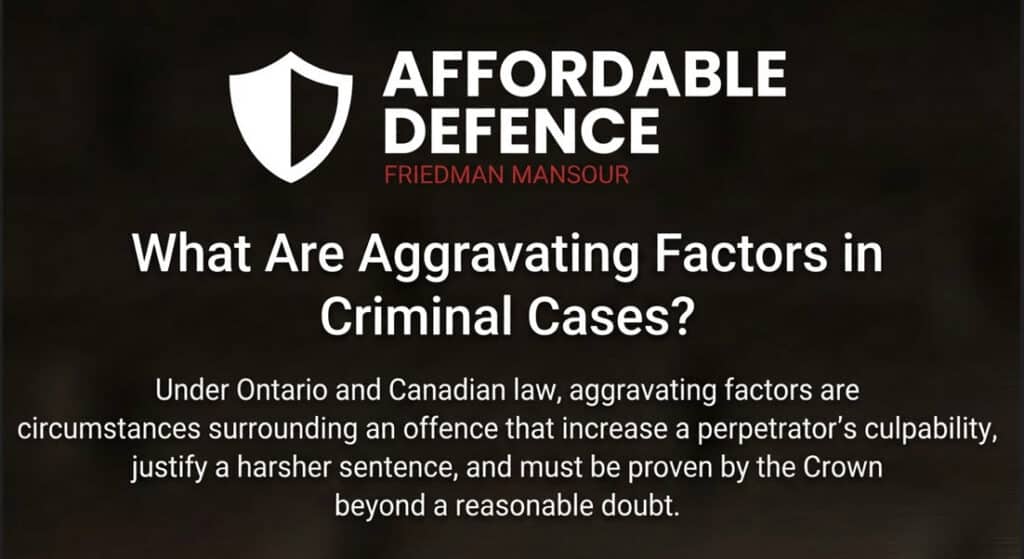
The 30-day minimum is a statutory floor, not a presumptive sentence. Judges may, and routinely do, impose sentences above the minimum where aggravating circumstances are present. The Criminal Code enumerates several statutory aggravating factors, alongside common law factors:
- A blood alcohol concentration at or above 120 mg% or 160 mg%.
- The presence of a passenger under the age of 16.
- Operation in a manner that resulted in bodily harm or death.
- Commission of the offence while subject to an existing driving prohibition.
- The proximity in time between the first and second offence.
Long-Term Collateral Consequences
Federal Driving Prohibition
In addition to any provincial administrative suspension, the sentencing court issues a Federal Driving Prohibition under s. 320.24 of the Criminal Code. For a second offence, this order carries a mandatory minimum prohibition of two years under the Criminal Code, up to a maximum of 10 years. The exact length is determined by the court’s discretion within that statutory range. Driving in contravention of a federal prohibition constitutes a separate criminal offence (Operation While Prohibited), which itself carries the potential of imprisonment.
Because the prohibition takes effect on the date of sentencing, it runs concurrently with, but effectively extends beyond, the period of incarceration.
Criminal Record & Record Suspensions
A conviction is recorded in the Canadian Police Information Centre database and remains on the accused’s record indefinitely unless a Record Suspension (formerly “Pardon”) is granted. The applicable waiting period before an application may be made is five years following completion of a sentence for a summary conviction offence, and ten years for an indictable offence.
United States Inadmissibility
A second impaired driving conviction significantly increases the risk of being denied entry to the United States. While not always an automatic legal bar unless specific aggregate sentence thresholds are met, multiple convictions often lead U.S. Customs and Border Protection officers to deny entry. Entry may be possible with a U.S. Entry Waiver (Form I-192), but the process is costly, subject to the discretion of U.S. Customs and Border Protection, and not guaranteed.
Trial Strategy and Charter Defences
Because the sentencing judge has no discretion to depart below the 30-day minimum once the Notice has been served, your defence lawyer’s primary objective in defending a second DUI charge is to prevent the conviction itself, not merely to mitigate the sentence.
One of the most common defence strategies is to ensure the exclusion of evidence under s. 24(2) of the Canadian Charter of Rights and Freedoms, following a finding that the accused’s Charter rights were violated during the investigation. The most commonly litigated arguments include:
- Section 8 (Unreasonable Search and Seizure)
This defence calls into question whether the police had the requisite reasonable suspicion to make an approved screening device demand, or reasonable grounds to make a breathalyzer demand. An unlawful stop or demand may render the breath samples unconstitutionally obtained.
- Section 10(b) (Right to Retain and Instruct Counsel)
This relates to whether the accused was promptly informed of their right to counsel and given a meaningful opportunity to consult with a lawyer in private. The defence also identifies whether the investigation was appropriately suspended until the right to counsel was exercised or waived.
- Section 24(2) (Exclusion of Breath Readings)
Defence lawyers may question whether the Crown has produced complete maintenance and calibration records for the approved instrument used to obtain breath evidence. Gaps in disclosure may support an application to exclude the breath evidence or stay the proceedings.
If breath evidence is excluded on a Charter application and the other evidence of impairment is insufficient, the Crown’s case will typically not withstand a motion for acquittal. Sentencing arguments, character references, treatment participation, and demonstrated rehabilitation remain relevant to the portion of the sentence above the mandatory minimum, but they cannot reduce the sentence below it.
Fight Your Second DUI Charge with Ontario’s Affordable Legal Team
The Crown relies on procedural steps like the Notice of Intention to enforce mandatory minimum sentences, but our experienced lawyers know how to fight back. We offer affordable, strategic DUI defence focused on protecting your rights under the Canadian Charter and keeping you out of jail.
Schedule your free consultation now to build a robust defence plan that fits your budget and protects your future.
Answers to Your Questions About Second DUI Charges
Will I serve my sentence in a federal penitentiary?
Sentences of less than two years are served in provincial correctional institutions. A 30-day sentence would be served in a provincial jail. Sentences of two years or longer are served in federal institutions.
Can I serve my sentence on weekends?
Intermittent sentencing is available under s. 732(1) of the Criminal Code for sentences of 90 days or less, but requires a specific application at the sentencing hearing and is not available as of right. It is subject to judicial discretion and the availability of facilities.
Does a curative discharge still exist?
No. The curative discharge was repealed in 2018 under Bill C-46. Participation in alcohol treatment programming is no longer available as a mechanism to avoid conviction or mandatory minimums, though it may be a relevant consideration in arguments regarding your sentence.
Can I negotiate a plea to avoid the criminal record entirely?
In some cases, the Crown may agree to resolve a matter as a provincial Careless Driving charge under the Highway Traffic Act, which carries no criminal record. However, this outcome typically requires significant evidentiary weaknesses in the Crown’s case and is not routinely available to second offenders.
Does a conviction in another province count as a prior DUI offence?
Yes. The Criminal Code is federal legislation applying Canada-wide. A conviction in any Canadian province or territory constitutes a prior conviction for second-offender sentencing.
Does a prior “Refusal” conviction make a new “Over 80” charge a second offence?
Yes. Under the Criminal Code, Impaired Operation (s. 320.14(1)), Operation Over 80 (s. 320.14(1)(b)), and Refusal to Comply (s. 320.15) are treated as equivalent for sentencing purposes. Any combination of two such convictions will qualify the second as a repeat offence.
Does the federal driving prohibition start after my release from custody?
Yes. s. 320.24 provides that a driving prohibition will be equal to the specified period of prohibition “plus the entire period to which the offender is sentenced to imprisonment.”
Resources and Governing Legislation
- Criminal Code, RSC 1985, c C-46, ss. 320.14, 320.15, 320.18, 320.24, 727, 732
- Department of Justice Canada — Impaired Driving Laws
